
Quartz
Quartz is a man-made stone made by blending 90% ground quartz stone with about 10% percent resins, polymers, and pigments. This forms a hard granite-like surface. This process is more environmentally friendly than granite. This material is formed under intense heat and pressure into a solid slab, which can be cut down to size. This process makes quartz more durable than other countertop options.
Quartz is more resistant to staining and does not chip easily but excessive heat can damage quartz so you must always use a heating pad.
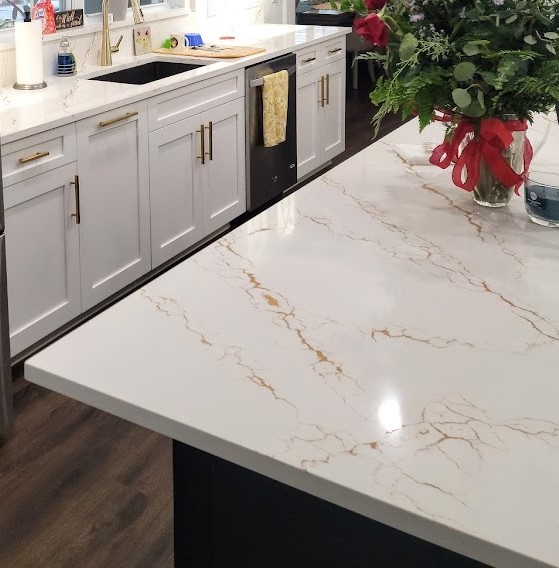
Colors and varieties of quartz are limitless and some quartz countertops are made to look like granite and marble. They can add flecks of color or sparkle such as mica or glitter.
Quartz can be custom-made to your specifications.
Quartz countertops do not have to be resealed.
Quartz can easily be cleaned with warm soapy water.
Granite
Granite is a natural stone that comes directly from stone quarries; it is cut into slabs and polished. This process uses a lot of energy and is less environmentally friendly than quartz
Granite is known for its beautiful veining features; some have more than others.
Each slab is unique and different, some have natural flecks of mica within the stone that sparkle.
Granite has over 3000 colors and variations.
It is more resistant to heat than quartz and marble but can stain if not properly sealed.
It can be prone to chip more easily than quartz.
Granite is usually less expensive than quartz.
Because granite is a natural stone, it will require maintenance. It comes sealed upon delivery. You will need to reseal your granite as recommended by your countertop professional, usually every 1-3 years.
Granite can be easily cleaned with warm soap and water.
Marble
Marble is a natural stone that comes directly from stone quarries.
Marble has a richness and a character to the stone that others can’t touch but what usually arouses people about marble countertops is the veining.
Each piece of marble is unique, which means that you get a very distinct look that cannot be replicated through synthetic marble.
Marble countertops come in a range of colors and have diverse color variations within their composition. Most natural marble has earth tones and includes flecks of white, tan, gray, green, brown or black.
Marble is softer and more porous than granite and quartz. It is susceptible to stains and scratches.
Marble is not completely heat resistant, so don’t place hot pots and pans directly on marble countertops.
You will find that some marble will be more than other countertop options while some are less expensive depending on the grading scale that the market assigns to your preferred stone choice.
Most stone experts recommend sealing your marble every 3-6 months depending on the color and quality of the stone.
Marble can easily be cleaned with warm soapy water.
Butcherblock
Butcher block countertops are wooden countertops that can come in various styles and colors.
When it comes to the looks of the counters, you can choose between many types of wood and even the grain type. Some of the options which you can choose from are reddish woods, such as cherry or red oak, or more natural-looking ones, such as bamboo or maple.
The biggest benefit of butcher block countertops is that you can use them as a cutting board although they are prone to scratching and sensitive to heat.
Because butcher block is wood you must keep them as dry as possible to avoid damage.
Butcher block needs to be sealed. It is a good idea to do a light sanding and add a coat or two every 6 months or so
Butcher block is generally one of the more affordable options for a kitchen countertop.

Conclusion:
No matter what type of material you end up choosing for your countertops, you need to think of it as a long-term investment. The fact is that countertops can be expensive but they are also supposed to last a long time. And no matter how careful you are, they naturally take something of a beating. Think about the long-term effects of investing in a countertop. By choosing the right material, you will be adding value to your home and creating a brand-new centerpiece of your kitchen. At the end of the day, it will come down to what you like, what colors are available and the maintenance you feel comfortable with.